- Published on
- • 8 min read
ONNX-Native Fine-Tuned Semantic Search in Drupal
- Authors

- Name
- Ching Chew
- Socials
Users searching a reports catalogue know the concept they want ("how many doctors do we have") but rarely the exact name a data modeller gave it ("GP FTE"). Keyword search fails because the query and the item share zero tokens. A sentence embedding model, fine-tuned on the domain's vocabulary and exported to ONNX, closes that gap by comparing meaning instead of strings, and it runs inside a Drupal 10 module using PHP 8.3, with no new software to install and no external API to call.
This post covers the PHP port: what it took to run ONNX inference in-process via FFI, and the GovCMS hosting trade-offs that come with it. For the fine-tuning details and model performance, see Auto Search: Semantic Search Inside the JVM.

The Drupal ecosystem's answer today
Every "local" AI search option in Drupal currently means one of three things:
- AI Search with an Ollama provider: a second service running alongside Drupal, 5 to 15 GB of RAM for a typical embedding model.
- AI Search or Semantic Search with OpenAI, Anthropic or Gemini: an external API call per query, a key to manage, and a cost that scales with traffic.
- Search API Embeddings: genuinely in-process, but built on Word2Vec (2013).
One new entrant has appeared since this project was scoped. Scolta builds a static lexical index at publish time with Pagefind and runs it entirely client-side in the browser, with an AI layer for query expansion and summaries. It is the closest thing to a "no search server" pitch, but there is no vector math and no model: it rewrites the query with an LLM and searches a lexical index, not a semantic one.
None of these run the embedding model inside the PHP process itself. For a small fine-tuned model, an INT8-quantised all-MiniLM-L6-v2 fine-tune is about 22 MB, this is entirely viable. Nobody in the Drupal ecosystem is doing it.
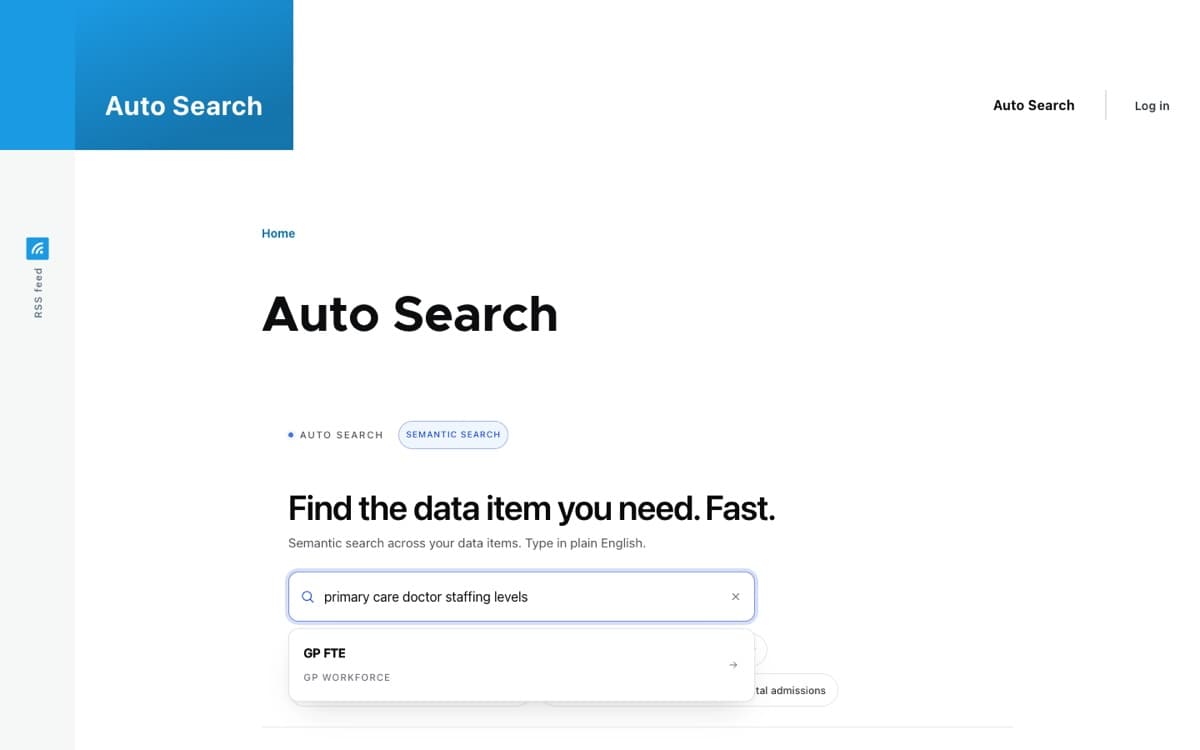
What porting to PHP actually required
The Vue 3 frontend needed no changes. It is compiled into the module directory and served as a Drupal library, exactly the pattern from an earlier Vue.js-in-Drupal talk. The interesting work is entirely on the backend.

The tokenizer is the hard part
The exported ONNX model takes pre-tokenized input_ids and attention_mask, not raw text. Java has DJL HuggingFace Tokenizers. PHP has no equivalent battle-tested library, so the WordPiece tokenizer got hand-ported, validated token-for-token against the Java and Python implementations:
public function encode(string $text): array {
  $normalized = $this->normalize($text);
  $words = $this->preTokenize($normalized);
  $ids = [self::CLS_ID];
  foreach ($words as $word) {
    foreach ($this->wordPiece($word) as $id) {
      $ids[] = $id;
      if (count($ids) >= self::MAX_LENGTH - 1) {
        break 2;
      }
    }
  }
  $ids[] = self::SEP_ID;

  $len = count($ids);
  return [
    'input_ids'      => $ids,
    'attention_mask' => array_fill(0, $len, 1),
    'token_type_ids' => array_fill(0, $len, 0),
  ];
}
wordPiece() is the classic longest-match-first algorithm against the BERT vocabulary, with a ## continuation prefix for subword pieces:
private function wordPiece(string $word): array {
  $chars = $this->mbStrSplit($word);
  $ids = [];
  $start = 0;
  $totalChars = count($chars);

  while ($start < $totalChars) {
    $end = $totalChars;
    $found = NULL;

    while ($start < $end) {
      $substr = implode('', array_slice($chars, $start, $end - $start));
      $lookup = ($start > 0) ? (self::CONTINUATION_PREFIX . $substr) : $substr;

      if (isset($this->vocab[$lookup])) {
        $found = $this->vocab[$lookup];
        break;
      }
      $end--;
    }

    if ($found === NULL) {
      return [self::UNK_ID];
    }

    $ids[] = $found;
    $start = $end;
  }

  return $ids;
}
Inference runs through FFI
ankane/onnxruntime-php wraps libonnxruntime.so via PHP's FFI extension. The class doing inference is OnnxRuntime\InferenceSession, not Session, the first of several small naming surprises:
public function embed(string $text): array {
  $enc = $this->tokenizer->encode($text);
  $session = $this->session();

  $inputs = [
    'input_ids'      => [$enc['input_ids']],
    'attention_mask' => [$enc['attention_mask']],
    'token_type_ids' => [$enc['token_type_ids']],
  ];

  $result = $session->run(NULL, $inputs);
  $hidden = $result[0][0];

  return $this->meanPoolAndNormalize($hidden, $enc['attention_mask']);
}
Masked mean pooling and L2 normalisation are hand-written, the same as the Java version, because PHP has no sentence-transformers equivalent either. Similarity is a for-loop, identical in shape to the Java SimilarityService:
public function search(array $queryVector, int $topK = 5): array {
  $scored = [];
  foreach ($this->items() as $item) {
    $scored[] = [
      'group_id' => $item['group_id'],
      'item_id'  => $item['item_id'],
      'name'     => $item['name'],
      'score'    => $this->dot($queryVector, $item['embedding']),
    ];
  }

  usort($scored, fn($a, $b) => $b['score'] <=> $a['score']);

  $results = [];
  foreach (array_slice($scored, 0, $topK) as $s) {
    if ($s['score'] < $this->minScore) {
      break;
    }
    $results[] = $s;
  }

  return $results;
}
Three hundred and fifty vectors, cosine similarity as a dot product because they are L2-normalised at embed time. No vector database. Same reasoning as the JVM version: at this scale, an operational dependency would buy nothing.
One caveat the JVM version does not have to answer: stock mod_php (which is what drupal:10-php8.3-apache runs) is share-nothing per request, unlike a long-lived Spring Boot process. The tokenizer vocab, the item embeddings and the ONNX session are all rebuilt from disk on every search request that hits a fresh worker, not loaded once at boot. lazy: true defers that cost to the first search request instead of every page load; it does not make the model persist across requests. No latency numbers for the PHP path are in this post yet: that is the next thing to measure before calling this production-ready.
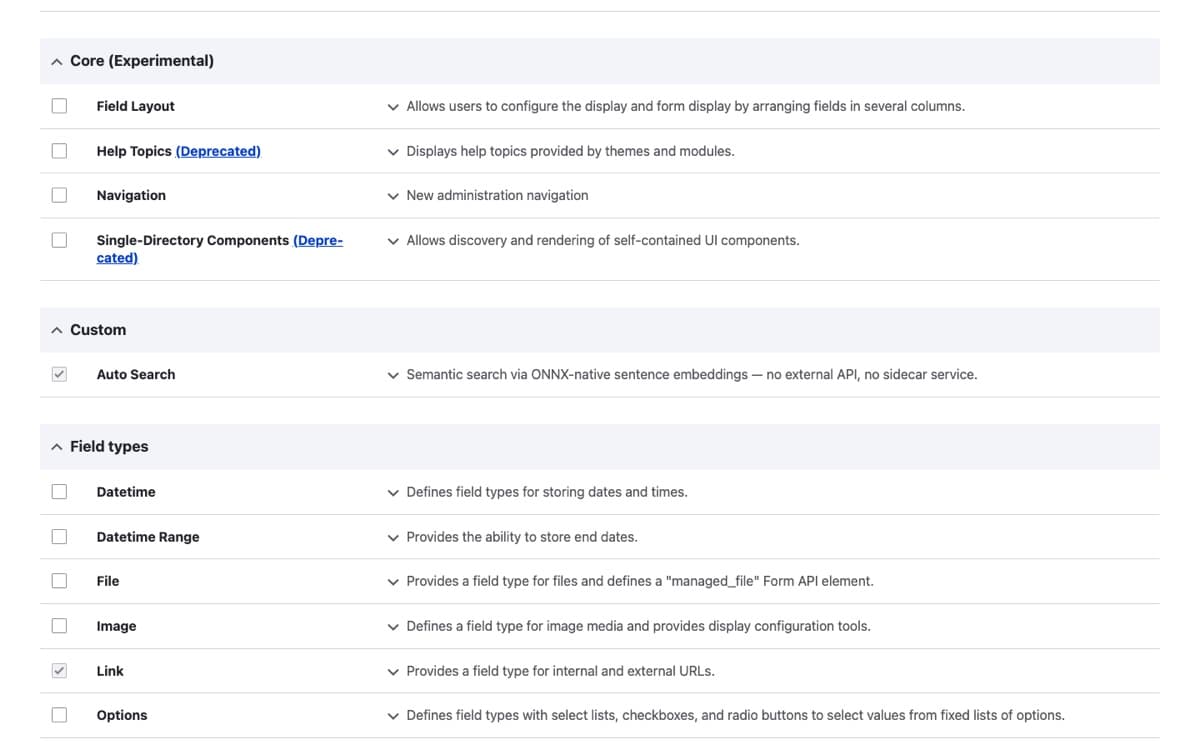
The module shows up in Drupal exactly like any other custom module, because it is one:
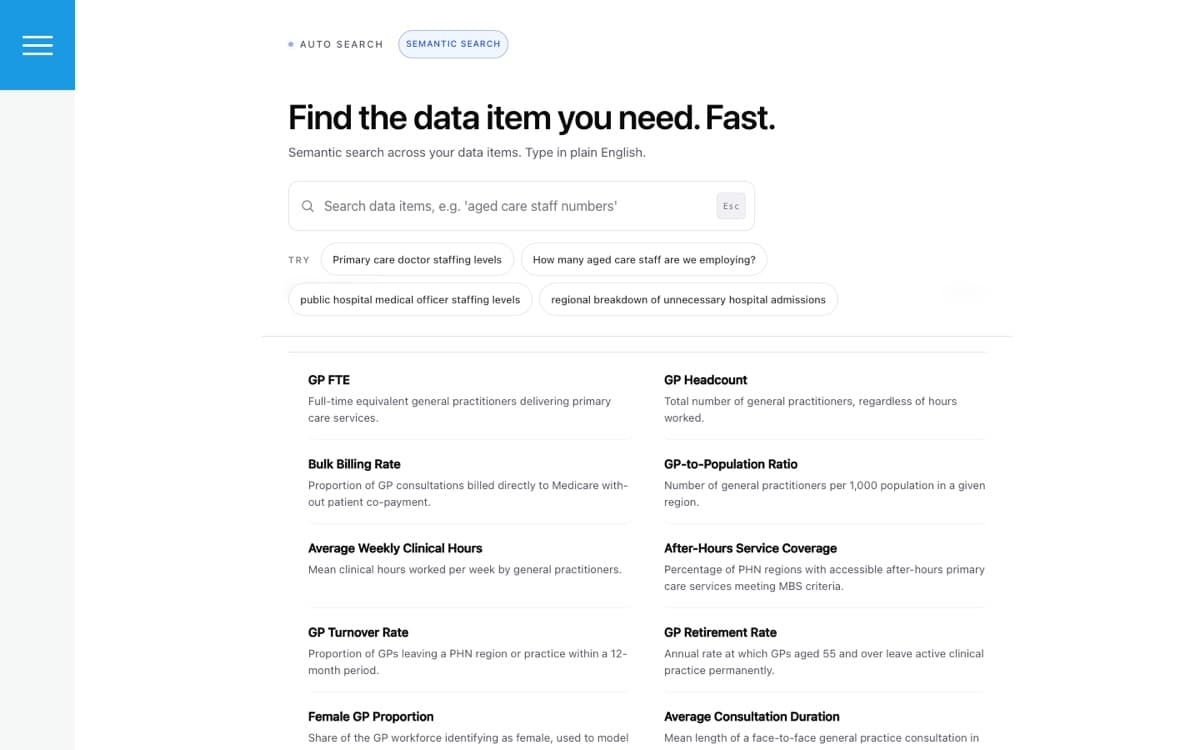
Selecting a result navigates to the item and highlights it, same as the JVM version:
Two deployment modes
ankane/onnxruntime-php needs libonnxruntime.so on the server. GovCMS, the Australian government's Drupal hosting platform, actually offers two different services here, and only one of them will support ONNX.
GovCMS PaaS is self-managed: the agency owns its own Docker image, built and deployed via Lagoon on Kubernetes. Custom modules are fully supported, and libonnxruntime.so is exactly as available as it is on any self-hosted Drupal install, because the agency controls the container.
GovCMS SaaS is fully managed with a fixed, approved module and theme set. A custom module can only ship if it joins that shared distribution and passes GovCMS's own review process, which explicitly screens for things like distribution bloat, so a module shipping its own native .so binary via FFI has no realistic path through it. Auto Search, or any bespoke module in this shape, needs PaaS or self-hosted. That isn't a limitation of the ONNX approach specifically, it is true of any custom code on SaaS.
This demo also skips production hardening that a real deployment would need regardless of hosting mode: all five routes currently allow anonymous access, and there is no scoped permission, config schema, uninstall hook or CSRF protection yet. More on that below.
| Self-hosted / GovCMS PaaS | GovCMS SaaS | |
|---|---|---|
| Custom modules at all | Yes, agency controls the container | Not permitted, approved module set only |
libonnxruntime.so | Install it, same as self-hosted | Moot, custom code isn't an option here |
Lessons learnt
FFI extension gaps bite on managed PHP images. drupal:10-php8.3-apache does not compile in the ffi or intl extensions by default. Both are required (FFI for the ONNX binding, intl's IntlChar for Unicode normalisation in the tokenizer) and both need adding to the Dockerfile explicitly. On a managed host without root access to the PHP build, this is a hosting-provider conversation before it is a code change.
Lazy service proxies break constructor type hints. Drupal generates proxy classes for services marked lazy: true, so the model only loads on the first actual search request instead of every page load. Those proxies do not extend the concrete class, so any constructor expecting EmbeddingService or SimilarityService by name gets a type error. The fix is typing the constructor parameter as object instead.
Where it goes next
Hybrid BM25 plus vector search. Rare or out-of-vocabulary tokens, acronyms and proper nouns the embedding model has not seen, underperform with pure vector search. A keyword fallback merged with vector scores would handle these gracefully.
Score calibration. The min_score threshold was set empirically, the same as the JVM version. A calibration step against a held-out query set would turn raw cosine similarity into something closer to a real confidence level.
Production hardening. Flagged above: scoped permissions, config schema, an uninstall hook that cleans up generated proxy classes, and CSRF protection if the module ever handles writes.
Code and Further Reading
The Drupal module lives on the drupal branch of the Auto Search repo. The stack is PHP 8.3, ankane/onnxruntime-php, PHP FFI, Drupal 10; the model and training pipeline are unchanged from the JVM version.
For the PHP ONNX binding, ankane/onnxruntime-php is well maintained with CI and 148 stars at the time of writing.
If your Drupal site has a search bar that fails on intent and adding a sidecar is not an option, swap in your own corpus.json and model artefacts and try it. That covers the search mechanics; field mapping, schema and reindexing for your own content are still on you.
AI Tools
Claude Code was used to plan and build the Drupal module, including porting the tokenizer and embedding pipeline from Java to PHP. Claude was used to draft this post.